
How to Measure for Custom Vinyl Stair Nosings & LVP Stair Treads For Installation

Looking for custom vinyl stair nosings made from your existing LVP or vinyl plank flooring? The first step is getting accurate measurements.
Custom vinyl stair nosings are a practical way to create a clean, professional-looking staircase while continuing the same flooring from your floor onto your stairs. At VinylNosing.com, we manufacture custom stair nosings from your actual vinyl or LVP flooring, helping match the flooring colour, pattern, texture, and original locking system.
Whether you are installing vinyl plank stair treads, LVP stair treads, SPC flooring on stairs, or custom vinyl stair nosings, accurate measurements are important for a successful installation.
This guide explains exactly how to measure for vinyl stair nosings, what measurements to provide, and what to consider before ordering.
What Is a Vinyl Stair Nosing?
A vinyl stair nosing is the finished front edge of a stair tread. It covers and protects the front edge of the stair while creating a finished transition between the horizontal stair tread and the vertical riser.
A custom vinyl stair nosing can be manufactured from the same LVP or vinyl plank flooring used elsewhere in your home. This provides a more consistent appearance than using a generic stair nosing that only approximately matches the flooring.
Our custom nosings are made from the flooring material whenever the product is suitable for manufacturing.
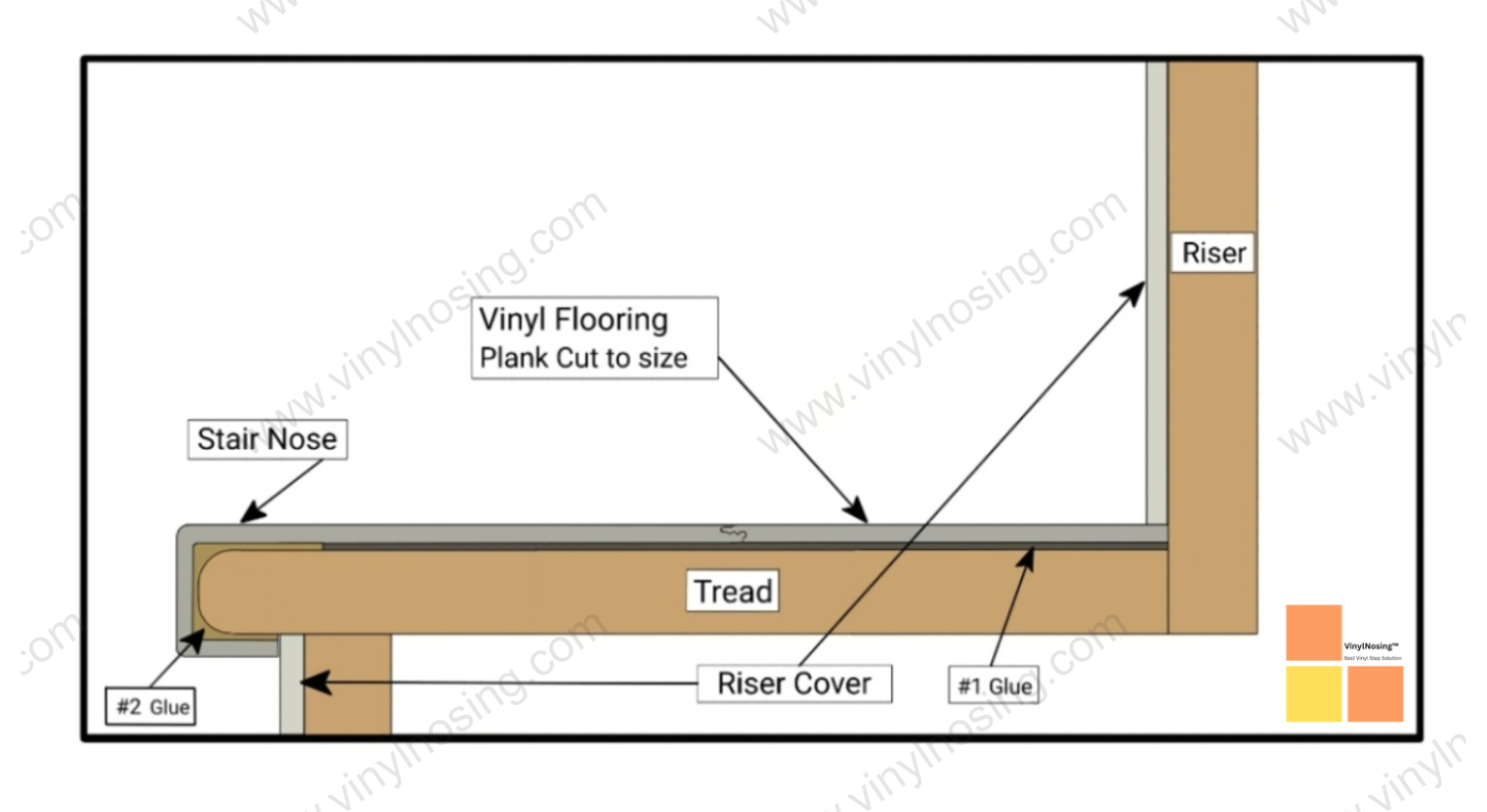
What Do You Need to Measure for Vinyl Stair Nosings?
Before ordering, measure the following for each step:
Bullnose Drop
Stair width — from one wall or side to the other
Tread depth — from the front edge of the step toward the back
Existing nosing or overhang — how far the current stair edge projects
Number of steps
Any differences between individual steps
Whether the stair is between two walls, open on one side, or open on both sides
You will only need a tape measure, pencil, and paper or your phone to record the measurements.


Important: Measure Every Stair Individually
Although a staircase may look uniform, individual stairs are not always exactly the same size.
Walls may not be perfectly straight or parallel, stair framing can vary slightly, and existing flooring installations can create small differences from one step to another.
For the most accurate result, measure every stair individually rather than assuming all stairs are identical.
This is especially important when ordering custom stair nosings because even small differences can affect the final installation.
Step 1: Measure the Stair Width
Measure the distance from one side of the stair to the other.
Take the measurement at the front of the tread, where the stair nosing will be installed.
Record the width for each stair.
For example:
Stair 1: 38 ¼"Stair 2: 38 ⅜"Stair 3: 38 ¼"
Even a small difference can be useful information when preparing your custom vinyl stair nosings.
What if my stair is wider than 48 inches?
Many vinyl flooring planks are approximately 47–48 inches long. If your staircase is wider than one plank, don't assume that a custom vinyl stair nosing cannot be made.
We preserve the flooring's side connection whenever the flooring construction allows it, which can allow multiple nosing pieces to be connected to create a longer continuous nosing.
We explain this in more detail below.
Step 2: Measure the Tread Depth
Next, measure from the front edge of the existing stair or nosing toward the back of the tread.
This tells you how much flooring is needed to cover the horizontal surface of the stair.
If you are replacing an existing nosing, make sure you understand where the new nosing will begin and how far the flooring needs to extend behind it.
The exact tread construction can vary depending on the staircase and flooring system, so photographs of the existing stairs can also be helpful.
Step 3: Measure the Existing Nosing or Overhang
If your stairs already have a nosing or overhang, measure how far it projects beyond the vertical riser.
This measurement helps us understand the existing stair configuration and determine the appropriate custom nosing profile.
A common measurement may be approximately 1" or 1½", but always measure your actual stairs rather than assuming.
Step 4: Check Both Sides of the Stair
Look carefully at both sides of the tread.
Ask:
Are the walls straight?
Is the stair wider at the front than at the back?
Are there gaps or irregular areas?
Is one side open?
Is the stair located between two walls?
This is particularly important for stairs located between walls because the walls may not be perfectly parallel.
Why Are Our Vinyl Stair Nosings Made at Plank Length?
Our custom vinyl stair nosings are made at approximately the original plank length, typically around 47–48 inches, rather than being cut to the exact stair width at the factory.
Why?
Because real stairs and walls are not always perfectly square.
The additional length gives the installer material to make the final precise cut on site, allowing the nosing to be fitted to the actual staircase.
This can be especially useful when stair widths vary slightly or when walls are not perfectly straight.
Step 5: Count Your Stairs
Count the total number of stair nosings you need.
For example:
15 stairs = 15 nosings
However, there is one more consideration we recommend before placing your order: spare nosings.
We Recommend Ordering 1–2 Extra Nosings
We recommend ordering 1–2 extra nosings with your project.
Having a spare piece available can be very helpful in case a nosing is accidentally damaged during installation or an installation mistake occurs.
Replacement nosings requested after the original order can be costly, and individual replacement requests may not be possible due to production requirements.
Having an extra nosing on hand can save you time, shipping costs, and the inconvenience of trying to obtain a replacement later.
For this reason, we strongly recommend ordering your spare nosings at the same time as your original order.
Our Custom Nosings Keep the Original Click-Lock Connections
One of the important advantages of our custom vinyl stair nosings is that we preserve the flooring's original click-lock connections whenever the flooring construction allows it.
This means the custom stair nosing can connect with another matching vinyl plank behind it to create a full stair tread.
Instead of removing the original connection system, we maintain it wherever possible so the flooring can continue naturally from the stair edge onto the tread.
This is particularly useful for homeowners and installers who want to use their existing LVP or vinyl plank flooring to create matching stair treads.
Wider Stairs? We Keep the Side Connections Too
What happens if your staircase is wider than one standard plank length of approximately 47–48 inches?
We preserve the side connection of the flooring whenever the flooring construction allows it, which means multiple custom stair nosing pieces can be connected to create a longer nosing.
For example, if your stair is approximately 70 inches wide, two nosing pieces can potentially be connected using the original flooring connection to cover the longer stair.
This allows us to work with wider staircases without requiring one unusually long custom piece.
The exact connection method depends on the construction of the particular flooring product. We preserve the original click-lock and side connections whenever the flooring allows it.
Can You Make Stair Nosings From My Existing Vinyl Flooring?
In many cases, yes.
One of our specialties is manufacturing custom stair nosings from the same vinyl or LVP flooring you already have.
This can be particularly useful when you want your stair treads and nosings to match an existing floor exactly.
We work with many popular flooring products and brands, including:
Lifeproof
TrafficMaster
Home Depot flooring
Costco flooring
Goodfellow
MSI
Home Decorators Collection
Golden Select
Mono Serra
Other vinyl and LVP flooring products
The flooring must be suitable for manufacturing. Not every vinyl, SPC, or hybrid flooring product can be used for every type of nosing.
Can Two Vinyl Stair Nosings Be Connected?
For wider stairs, multiple nosing pieces can potentially be connected using the original flooring side connection when the flooring construction allows it.
This means a staircase wider than approximately 47–48 inches may be possible without creating a completely new oversized piece.
For example:
70" stair width → two connected nosing pieces
This approach allows the original flooring connection to remain functional while creating the required overall length.
Do You Make Stair Nosings From Hybrid or SPC Flooring?
Some hybrid and SPC flooring products are suitable for custom stair nosings, while others are not.
We do not bend hybrid flooring when the bending process can cause the surface to crack.
We also do not manufacture laminate stair nosings.
If you are unsure whether your flooring is suitable, send us the flooring information and photos before ordering.
Measuring Worksheet for Custom Stair Nosings
Use this worksheet to record your measurements:
Stair # | Width | Tread Depth | Overhang | Notes |
1 | ||||
2 | ||||
3 | ||||
4 | ||||
5 | ||||
6 | ||||
7 | ||||
8 | ||||
9 | ||||
10 |
Continue the list for all of your stairs.
What Measurements Should You Send Us?
When requesting custom vinyl stair nosings, please provide:
Number of stairs
Width of each stair
Tread depth
Existing nosing or overhang measurement
Photos of the stairs, if possible
The flooring product or brand, if known
Whether the stairs are between walls, open on one side, open on both sides, or have another configuration
Photos are especially helpful when there are unusual stair shapes, transitions, existing nosings, or wider stairs requiring multiple connected nosing pieces.
Don't Have Perfectly Identical Stairs?
That's completely fine.
In fact, this is one of the reasons we recommend measuring each stair individually.
If your stairs have slightly different widths or depths, simply provide us with the measurements.
Our plank-length custom nosings give the installer additional material for making the final precise cuts during installation.
How to Install Custom Vinyl Stair Nosings
Accurate measuring is only the first part of a successful stair project.
Once your custom vinyl stair nosings arrive, proper installation is equally important.
We provide vinyl stair nosing installation videos with helpful information about installing custom nosings and creating a finished vinyl plank stair tread.
Frequently Asked Questions About Vinyl Stair Nosings
How do I measure for a vinyl stair nosing?
Measure the width of each stair, the tread depth, and the existing nosing or overhang. We also recommend checking both sides of each stair and providing photos whenever possible.
Can stair nosings be made from vinyl plank flooring?
Yes, suitable vinyl plank and LVP flooring can be used to manufacture custom stair nosings. Using the same flooring can provide a much closer match to your existing floor than a generic nosing.
Can I use my leftover LVP to make stair nosings?
Yes, if the flooring is suitable for manufacturing. Contact us with the flooring brand, product information, and photos to determine whether it can be used.
How long are vinyl stair nosings?
Our nosings are generally made at approximately the original plank length, typically 47–48 inches. The additional length allows the installer to make the final precise cut on site.
What if my stairs are wider than 48 inches?
Multiple nosing pieces can potentially be connected using the original flooring side connection when the flooring construction allows it.
Do you preserve the click-lock connection?
Yes. We preserve the original click-lock connection whenever the flooring construction allows it. This can allow the nosing to connect with another matching plank to create a full stair tread.
How many extra stair nosings should I order?
We recommend ordering 1–2 extra nosings with your original order. This provides a spare in case of accidental damage or an installation mistake.
Can I order a replacement nosing later?
Replacement requests made after the original order can be costly, and individual replacement requests may not be possible because of production requirements. For this reason, ordering 1–2 spare nosings with your original order is recommended.
Do you make laminate stair nosings?
No. We manufacture custom vinyl and suitable LVP stair nosings, but we do not manufacture laminate stair nosings.
Do you make bent stair nosings from hybrid flooring?
We do not bend hybrid flooring when bending can cause the surface to crack. The suitability of a particular SPC or hybrid product depends on its construction.
Do you ship custom vinyl stair nosings across Canada?
Yes. Custom vinyl stair nosings are available for shipping across Canada and the USA.
Need Help With Your Measurements?
If you are unsure about your measurements, flooring type, or whether your particular flooring can be used for custom stair nosings, contact us before ordering.
Send us your flooring information, stair measurements, and photos, and we can help you understand what information is needed for your custom nosing project.
Ready to Order Custom Vinyl Stair Nosings?
Custom vinyl stair nosings are made from your flooring and designed specifically for your staircase.
Custom-made from your flooring. Designed for your stairs. Made at plank length for precise on-site cutting. Original click-lock and side connections preserved whenever applicable. Multiple pieces can be connected for wider stairs. Available for shipping across Canada and the USA.
Measure carefully, provide photos when possible, and consider ordering 1–2 spare nosings with your original order for a smoother installation experience. Contact Us If You Have More Question.


Comments